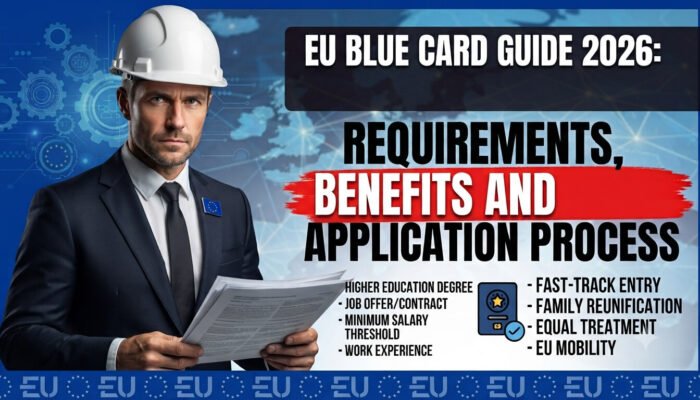
EU Blue Card is one of the most important immigration pathways for highly qualified professionals who want to live and work in Europe. Designed to attract skilled workers from outside the European Union, the EU Blue Card allows eligible professionals to access employment opportunities while benefiting from a structured residence system.
As European countries continue to experience shortages in areas such as technology, engineering, healthcare, research, and other specialised fields, the demand for international talent has increased. The EU Blue Card provides a legal framework that helps companies recruit qualified professionals while offering foreign workers a pathway to build their careers in participating European countries.
This guide explains what the EU Blue Card is, who can apply, the main eligibility requirements, key advantages, and important considerations for applicants planning their future in Europe.
What Is the EU Blue Card?
The EU Blue Card is a residence and work permit created for highly qualified non-EU citizens who have a valid employment opportunity in an EU country. It combines work authorization and residency rights, allowing qualified professionals to legally live and work in the country that issues the permit.
The program was introduced to make Europe more attractive to international talent and to compete globally for skilled professionals. Although the EU Blue Card follows a common European framework, each participating country manages its own application procedures, salary requirements, processing times, and additional conditions.
Applicants should therefore check the specific rules of the country where they intend to work before submitting an application.
Why Was the EU Blue Card Created?
European economies require skilled workers in many sectors where local labour supply does not always meet demand. The EU Blue Card was developed to support economic growth by making it easier for qualified professionals from outside Europe to access employment opportunities.
The program aims to:
- Attract highly qualified professionals to European countries.
- Address shortages in specialised industries.
- Create a transparent immigration pathway for skilled workers.
- Support innovation and economic development.
- Improve Europe’s ability to compete for global talent.
For employers, the system provides access to a larger international talent pool. For workers, it offers a recognised route to professional opportunities and long-term residence options.
Who Can Apply for an EU Blue Card?
The EU Blue Card is generally intended for non-EU nationals who have higher education qualifications or significant professional expertise and have received a qualifying job offer in a participating country.
Typical applicants include:
- Software developers and IT specialists.
- Engineers.
- Medical professionals.
- Scientists and researchers.
- University professionals.
- Financial and business specialists.
- Other highly qualified professionals.
Eligibility requirements differ between countries, but applicants normally need to demonstrate education, professional qualifications, and an employment contract that meets the required conditions.
EU Blue Card Requirements
Although requirements vary depending on the destination country, most EU Blue Card applications require applicants to meet several common conditions.
1. Valid Employment Contract
Applicants usually need a confirmed job offer or employment contract from an employer located in the country where they are applying. The position must normally meet minimum salary requirements established by national authorities.
2. Higher Education Qualification
Many applicants must provide evidence of a university degree or equivalent higher education qualification. In some professions, recognised professional experience may also be considered depending on national rules.
3. Salary Requirements
One of the key elements of the EU Blue Card system is the salary threshold. Applicants generally need to earn above a minimum salary level to qualify.
The exact amount depends on the country, occupation, and current regulations. Shortage occupations may have different thresholds compared with other professional roles.
4. Health Insurance and Legal Requirements
Applicants must usually provide proof of health insurance coverage and satisfy general immigration requirements, including valid travel documents and compliance with national regulations.
Benefits of the EU Blue Card
The EU Blue Card offers several advantages compared with some other work permits available to foreign nationals.
- Legal residence and employment rights in a participating EU country.
- Access to professional opportunities in specialised industries.
- Improved mobility options within Europe after meeting certain conditions.
- Potential pathway toward long-term residence.
- Ability to bring eligible family members.
- Greater employment stability compared with temporary work arrangements.
For many professionals, the EU Blue Card represents more than a work permit. It can become part of a long-term career and settlement strategy in Europe.
EU Blue Card Application Process
The application process for an EU Blue Card depends on the country where the applicant intends to work. While the overall concept is similar across participating countries, each national immigration authority has its own procedures, forms, processing times, and documentation requirements.
In most cases, applicants should follow these general steps:
Step 1: Find a Qualified Job Opportunity
The first step is securing an employment offer that meets the requirements of the destination country. The position should normally match the applicant’s qualifications and satisfy the minimum salary threshold established for the EU Blue Card program.
Many applicants begin their search through international recruitment platforms, company career websites, professional networks, and specialised employment agencies.
Step 2: Prepare Required Documents
Applicants usually need to provide several supporting documents during the application process. These may include:
- Valid passport or travel document.
- Signed employment contract or binding job offer.
- University degree or proof of professional qualifications.
- Proof of salary requirements.
- Health insurance documentation.
- Proof of accommodation where required.
- Completed application forms.
- Additional documents requested by national authorities.
Preparing complete and accurate documentation can help prevent delays during the review process.
Step 3: Submit the Application
Depending on the country, applications may be submitted through an embassy, consulate, immigration office, or online government platform. Applicants should check the official immigration website of their destination country for the latest procedures.
Step 4: Receive Approval and Begin Employment
After approval, the applicant receives the EU Blue Card residence permit and can begin working according to the conditions specified in the permit.
Applicants should carefully review the conditions attached to their permit, including employer restrictions, reporting obligations, and renewal requirements.
EU Blue Card vs Regular Work Permit
Many foreign professionals compare the EU Blue Card with traditional work permits. While both allow non-EU nationals to work legally in Europe, there are important differences.
| EU Blue Card | Regular Work Permit |
|---|---|
| Designed mainly for highly qualified professionals | May apply to a wider range of workers |
| Usually requires higher education qualifications | Requirements vary significantly |
| Often provides stronger mobility options | Usually linked to one employer or country |
| May support long-term residence pathways | Benefits depend on national rules |
The best option depends on the applicant’s qualifications, occupation, destination country, and long-term goals.
Family Members and EU Blue Card Holders
One important advantage of the EU Blue Card is that eligible holders may be able to bring family members to join them in Europe.
Family reunification rules vary by country, but spouses and dependent children are commonly included under applicable immigration regulations.
Family members may also receive residence rights and, depending on national legislation, may have access to employment opportunities.
Applicants planning to relocate with their families should review the specific requirements of the country where they intend to live.
Changing Employers With an EU Blue Card
EU Blue Card holders may have opportunities to change employers, but the process depends on the rules of the issuing country.
Some countries require notification or approval before changing employment, especially during the initial period after receiving the permit. Workers should always confirm the requirements before accepting a new position.
Failing to follow employment conditions can create immigration issues and may affect future residence applications.
Moving Between EU Countries With an EU Blue Card
The EU Blue Card system provides certain mobility benefits for qualified workers who want to develop their careers in Europe.
After meeting specific residence requirements, Blue Card holders may have opportunities to move to another participating EU country and apply for a new permit there.
However, the EU Blue Card does not automatically provide unrestricted permission to work anywhere in Europe. Each country maintains its own immigration procedures and eligibility requirements.
Common Mistakes EU Blue Card Applicants Should Avoid
Many application problems can be avoided with careful preparation. Common mistakes include:
- Applying without checking country-specific requirements.
- Submitting incomplete documentation.
- Ignoring salary threshold rules.
- Using outdated information from unofficial websites.
- Failing to verify qualification recognition requirements.
- Not understanding employment restrictions.
- Missing residence permit renewal deadlines.
Applicants should always rely on official immigration information and prepare their application carefully.
Useful Official Resources
For accurate and updated information about the EU Blue Card, applicants should consult official European and national government resources:
-
European Commission – EU Blue Card Information
-
Official Website of the European Union
-
EURES European Job Mobility Portal
Related Articles
Frequently Asked Questions About the EU Blue Card
How long is an EU Blue Card valid?
The validity period depends on the issuing country. Many EU countries issue Blue Cards for a period ranging from one to several years, with renewal options available if eligibility conditions continue to be met.
Can I apply for permanent residence with an EU Blue Card?
In many cases, EU Blue Card holders may become eligible for long-term residence after meeting specific requirements, including residence duration and legal conditions established by national authorities.
Can I bring my family with an EU Blue Card?
Yes, eligible family members may often join the Blue Card holder through family reunification procedures. Requirements differ between EU countries.
Is the EU Blue Card available in every European country?
The EU Blue Card applies in participating EU Member States, but each country manages its own application process and requirements. Applicants should verify rules with the relevant national immigration authority.
Conclusion
The EU Blue Card has become an important pathway for skilled professionals seeking career opportunities in Europe. By combining employment rights with residence benefits, it provides qualified non-EU workers with a structured option for building their professional future.
For employers, the program offers access to international talent in industries facing skill shortages. For applicants, it provides opportunities to work legally, develop careers, and potentially establish long-term residence in Europe.
Successful applications depend on careful preparation, understanding country-specific requirements, and using reliable official information sources. As European economies continue competing for skilled professionals, the EU Blue Card is expected to remain a valuable immigration route for qualified workers worldwide.