
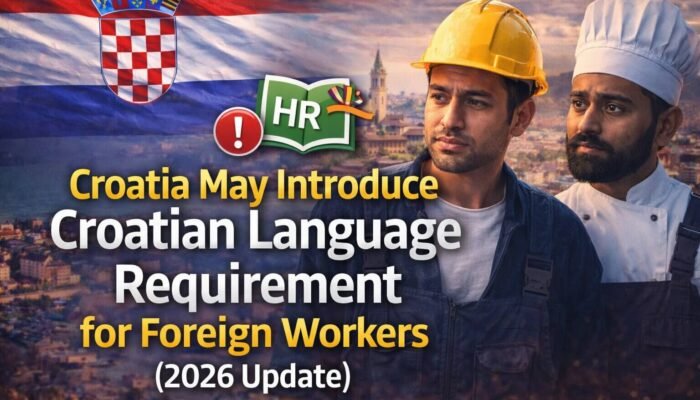
Croatia is considering new immigration rules that could require foreign workers to demonstrate basic knowledge of the Croatian language when renewing their residence or work permits. The proposed change is part of amendments to the Croatian Foreigners Act and aims to improve workplace communication and social integration. Croatia has experienced a significant increase in the number of foreign workers in recent years. Due to labor shortages in sectors such as tourism, construction, hospitality, and agriculture, employers increasingly rely on workers from non-EU countries.
Why Croatia Is Considering a Language Requirement
Government officials have stated that introducing a basic Croatian language requirement could help foreign workers better integrate into Croatian society and improve communication at workplaces. The main goals of the proposal include:
- Improving communication between workers and employers
- Helping foreign workers integrate into local communities
- Ensuring workplace safety through better understanding of instructions
- Encouraging long-term integration of foreign workers
Who Could Be Affected by the New Rule?
If the proposal is approved, the language requirement would likely apply to third-country nationals working in Croatia who need to renew their residence or work permits. Most foreign workers in Croatia come from countries such as:
- Nepal
- Philippines
- India
- Bangladesh
- Bosnia and Herzegovina
- Serbia
These workers are commonly employed in industries experiencing labor shortages, including tourism, construction, and food services.
What Level of Croatian Language May Be Required?
According to early reports, the proposed rule may require foreign workers to demonstrate basic Croatian language knowledge at approximately the A1 level of the Common European Framework of Reference for Languages (CEFR). An A1 level typically means the ability to:
- Understand basic everyday phrases
- Introduce oneself and ask simple questions
- Communicate basic needs at work
- Follow simple instructions
However, the final details of the requirement will depend on the official legislation once it is formally adopted.
Current Situation for Foreign Workers in Croatia
Croatia continues to rely heavily on foreign workers due to ongoing labor shortages. In recent years, the country has issued more than one hundred thousand work permits annually to foreign nationals. The tourism industry, which plays a major role in Croatia’s economy, requires thousands of seasonal workers every year. Many employers recruit workers from Asia and neighboring Balkan countries to fill available positions.
What Foreign Workers Should Know
- The language requirement has been discussed but may still require full legislative approval.
- Foreign workers currently holding valid permits can continue working under existing rules.
- If introduced, the language test may apply mainly when renewing work or residence permits.
- Employers may also support workers with language training programs.
Conclusion
Croatia is exploring the possibility of introducing a basic Croatian language requirement for foreign workers as part of broader immigration policy updates. The goal is to improve workplace communication and support integration while continuing to address the country’s labor shortages. Foreign workers planning to work in Croatia should stay informed about future changes to immigration rules and language requirements.
Frequently Asked Questions (FAQ)
Will foreign workers need to learn Croatian to work in Croatia?
Currently, foreign workers are not required to pass a Croatian language test to obtain a work permit. However, future legislation may introduce a basic language requirement for permit renewals.
What level of Croatian language may be required?
Reports suggest that a basic A1 level of Croatian may be required. This level focuses on simple communication and everyday phrases.
When could the new rule start?
The exact start date has not been confirmed yet. The proposal must first go through the legislative process before becoming law.
Will this rule affect all foreign workers?
The requirement would likely apply mainly to third-country nationals who renew their work or residence permits in Croatia. EU citizens are generally not affected by such requirements.
Why does Croatia need foreign workers?
Croatia faces labor shortages in several industries, including tourism, construction, agriculture, and hospitality. Foreign workers help fill these gaps and support the country’s economy.
Disclaimer: This article is for informational purposes only. It does not constitute legal or immigration advice. For official information, consult the Croatian Ministry of Interior or relevant government authorities.







One reply on “Croatia May Introduce Croatian Language Requirement for Foreign Workers (2026 Update)”
Greetings from Ohio! I’m bored to tears at work so I decided to
browse your website on my iphone during lunch break.
I enjoy the info you provide here and can’t wait to take a look when I get home.
I’m surprised at how quick your blog loaded on my
cell phone .. I’m not even using WIFI, just 3G ..
Anyhow, great site!