
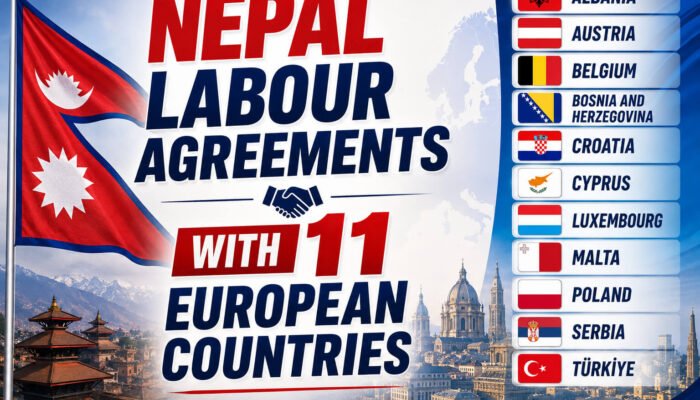
Nepal Labour Agreements with 11 European Countries have become a major topic of discussion as the Government of Nepal takes steps to expand overseas employment opportunities beyond its traditional labour markets. The Ministry of Labour, Employment and Social Security has formally proposed bilateral labour agreements with 11 European nations, aiming to create safer, more transparent, and better-regulated migration pathways for Nepali workers.
The initiative reflects Nepal’s long-term strategy to diversify foreign employment destinations while reducing dependence on Gulf countries and Malaysia, where the majority of Nepali migrant workers have traditionally been employed. By exploring opportunities in Europe, the government hopes to improve employment standards, strengthen worker protection, and open access to industries experiencing labour shortages.
Why Nepal Is Expanding Labour Agreements
Foreign employment remains one of Nepal’s largest sources of income, with remittances contributing significantly to the national economy. Every year, hundreds of thousands of Nepali citizens leave the country in search of better employment opportunities abroad.
While Gulf nations such as Qatar, Saudi Arabia, the United Arab Emirates, Kuwait, and Oman continue to employ large numbers of Nepali workers, the government has increasingly looked toward Europe as an alternative destination offering diversified career opportunities and stronger labour protections.
The latest proposal demonstrates Nepal’s commitment to creating safer migration channels while reducing risks associated with informal recruitment and illegal employment practices.
Which European Countries Have Received the Proposal?
According to officials from the Ministry of Labour, Employment and Social Security, formal proposals have been sent to the following eleven European countries:
- Albania
- Austria
- Belgium
- Bosnia and Herzegovina
- Croatia
- Cyprus
- Luxembourg
- Malta
- Poland
- Serbia
- Türkiye
At this stage, these are proposals for bilateral labour agreements. Negotiations and discussions with each country will determine whether formal agreements are signed in the future.
What Are Bilateral Labour Agreements?
Bilateral labour agreements are formal arrangements between two governments that establish rules governing the recruitment and employment of migrant workers. These agreements are intended to protect workers while providing employers with access to qualified foreign labour under clearly defined conditions.
Although each agreement may differ depending on the participating countries, they often include provisions covering:
- Recruitment procedures.
- Employment contracts.
- Minimum wages.
- Working conditions.
- Accommodation standards.
- Dispute resolution mechanisms.
- Worker rights and responsibilities.
- Employer obligations.
Such agreements can help reduce exploitation and improve transparency throughout the overseas employment process.
Why Europe Is Becoming More Attractive
Many European countries are facing labour shortages caused by ageing populations, declining birth rates, and increasing demand in sectors such as healthcare, construction, hospitality, transportation, manufacturing, agriculture, and information technology.
As businesses struggle to recruit enough local workers, governments are increasingly considering international recruitment to fill essential positions.
For Nepali workers, Europe offers the possibility of employment in regulated labour markets with stronger workplace protections compared with some traditional overseas destinations.
Potential Benefits for Nepali Workers
If bilateral agreements are successfully concluded, Nepali workers could gain access to several important advantages.
- Greater legal protection.
- More transparent recruitment procedures.
- Improved employment contracts.
- Better monitoring of recruitment agencies.
- Safer migration pathways.
- Access to new employment sectors.
- Potentially improved wages and working conditions.
Government-to-government cooperation may also help reduce illegal recruitment practices that have affected some migrant workers in the past.
Opportunities Across Different Industries
The proposed agreements could create opportunities across multiple industries experiencing labour shortages throughout Europe.
Possible sectors include:
- Construction.
- Hospitality and tourism.
- Agriculture.
- Manufacturing.
- Transportation and logistics.
- Healthcare support services.
- Food processing.
- Skilled technical trades.
The actual opportunities available will depend on the labour market needs of each participating country and the terms negotiated under future agreements.
What This Means for Recruitment Agencies
Nepal’s licensed recruitment agencies could play an important role if labour agreements are finalized. However, stronger government oversight and clearly defined recruitment standards may become central features of any future bilateral arrangements.
Recruitment agencies may need to comply with updated procedures designed to improve transparency, reduce recruitment fraud, and ensure workers receive accurate information before travelling abroad.
An Important Clarification
Although the announcement has generated significant public interest, it is important to understand that Nepal has not yet signed labour agreements with these eleven European countries. The government has formally proposed such agreements, and discussions are expected to continue through diplomatic and administrative channels.
Whether agreements are ultimately concluded will depend on negotiations between Nepal and each respective government.
Challenges Before Agreements Become Reality
Although Nepal has formally proposed bilateral labour agreements with 11 European countries, the process is still in its early stages. Bilateral agreements require negotiations between governments, legal reviews, and mutual approval before they can be implemented.
Each European country has its own immigration laws, labour market policies, and recruitment requirements. As a result, negotiations may progress at different speeds, and some countries may require additional discussions before reaching a final agreement.
Employers in Europe must also comply with national employment laws, minimum wage regulations, and work permit procedures. Therefore, even after an agreement is signed, individual workers will still need to meet the immigration and employment requirements of their destination country.
What the Agreements Could Mean for Nepal’s Economy
Foreign employment continues to play an important role in Nepal’s economic development. Money sent home by Nepali workers abroad contributes significantly to household income, education, healthcare, and local business investment.
If labour agreements with European countries are successfully concluded, Nepal could diversify its overseas employment destinations and reduce reliance on a limited number of labour markets. A broader range of destinations may also help improve employment stability if demand declines in one particular region.
In addition, workers employed in regulated labour markets may benefit from stronger employment protections and more structured recruitment processes, contributing to safer foreign employment overall.
Possible Opportunities for Skilled and Semi-Skilled Workers
European countries experiencing labour shortages are recruiting workers across a variety of industries. While future opportunities will depend on the terms of any bilateral agreements, demand may exist in sectors such as:
- Construction and infrastructure projects.
- Hospitality and tourism.
- Agriculture and seasonal work.
- Manufacturing and production.
- Transportation and logistics.
- Healthcare support services.
- Engineering and technical occupations.
- Food processing and industrial operations.
Some countries may also seek professionals with specialised qualifications, language skills, or previous international work experience.
Advice for Nepali Workers
Individuals interested in future employment opportunities in Europe should avoid making decisions based solely on social media posts or unofficial announcements. Since the proposed labour agreements are still under discussion, workers should wait for official government updates before applying for jobs or paying recruitment fees.
Prospective migrant workers should also:
- Verify that recruitment agencies are licensed.
- Read employment contracts carefully.
- Understand visa and work permit requirements.
- Attend any mandatory pre-departure orientation programmes.
- Keep copies of important documents.
- Confirm salary, accommodation, and working conditions before travelling.
Following official procedures can help reduce the risk of fraud and ensure workers understand their legal rights and responsibilities.
Role of Bilateral Labour Agreements
Bilateral labour agreements are intended to create a structured framework for overseas employment. In many cases, these agreements improve cooperation between governments by defining recruitment standards, worker protections, employer responsibilities, and mechanisms for resolving employment-related issues.
For workers, such agreements can increase confidence that recruitment and employment processes are supported by government oversight rather than relying entirely on private arrangements.
Official Resources
Workers seeking information about overseas employment should rely on official government sources for the latest announcements and guidance.
- Ministry of Labour, Employment and Social Security (Nepal)
- Department of Foreign Employment
- Government of Nepal
Related Articles
Frequently Asked Questions
Has Nepal signed labour agreements with all 11 European countries?
No. As of now, Nepal has formally proposed bilateral labour agreements to 11 European countries. The agreements have not yet been finalized or signed.
Which countries received Nepal’s proposal?
The proposal has been sent to Albania, Austria, Belgium, Bosnia and Herzegovina, Croatia, Cyprus, Luxembourg, Malta, Poland, Serbia, and Türkiye.
Will Nepali workers automatically be able to work in these countries?
No. Even if agreements are signed in the future, workers will still need to meet each country’s visa, work permit, and immigration requirements before employment.
Why is Nepal seeking more labour agreements with Europe?
The government aims to diversify overseas employment destinations, improve worker protection, expand legal migration opportunities, and support safer and more transparent foreign employment.
Nepal Labour Agreements with 11 European Countries represent an important step toward expanding overseas employment opportunities and strengthening the protection of Nepali migrant workers. While the government has officially initiated the process by sending proposals to several European nations, negotiations are still ongoing, and no final agreements have yet been announced.
If successful, these partnerships could create new employment opportunities across multiple industries while improving recruitment standards, worker rights, and government cooperation. However, prospective workers should rely only on official announcements and avoid misinformation or unauthorized recruitment offers.
As discussions continue, the initiative reflects Nepal’s broader strategy to diversify foreign employment destinations and support safer, more transparent labour migration for its citizens.