
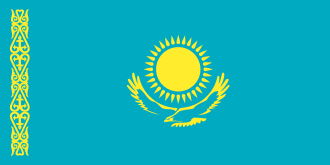
Kazakhstan
Kazakhstan, officially the Republic of Kazakhstan, is a country in Central Asia, with a small portion in Eastern Europe. It is bordered by Russia, China, Kyrgyzstan, Uzbekistan, and Turkmenistan, and has a coastline along the Caspian Sea. Kazakhstan is known for its vast steppes, natural resources, and rapidly developing economy.
Kazakhstan covers an area of approximately 2,724,900 square kilometres and has a population of around 19 million people as of 2024–2025.
Key Country Information
- Capital City: Astana (Nur-Sultan)
- Head of State (President): Kassym-Jomart Tokayev
- Head of Government (Prime Minister): Alihan Smaiylov
- Official Languages: Kazakh, Russian
- Currency: Kazakhstani Tenge (KZT)
- International Dialing Code: +7
Population and Economy
Kazakhstan has a population of approximately 19 million. Its economy is resource-rich, with major sectors including oil, gas, mining, agriculture, and services.
Key industries include energy production, mining, metallurgy, agriculture, and transportation. Kazakhstan is a major regional trade hub in Central Asia and is strategically important for international trade corridors.
International Memberships
- United Nations (UN): Member since 1992
- Shanghai Cooperation Organization (SCO): Member since 2001
- Commonwealth of Independent States (CIS): Member since 1991
- Organization for Security and Co-operation in Europe (OSCE): Member since 1992
- Economic Cooperation Organization (ECO): Member since 1992
Living and Working in Kazakhstan
Living in Kazakhstan varies by region. Major cities like Astana (Nur-Sultan), Almaty, and Shymkent have modern infrastructure, while rural areas are less developed. The cost of living is moderate compared to many other countries.
Foreign nationals require a residence permit and work visa to work legally. Employment opportunities exist in energy, construction, education, IT, and international organizations, often requiring employer sponsorship.
Summary
Kazakhstan is a large Central Asian country with abundant natural resources, a developing economy, and a strategic location. It is a member of the UN, SCO, CIS, OSCE, and ECO, actively participating in regional and international cooperation.